
Direct answer
Should I aim for a negative split in a marathon or half marathon?
A negative split means covering the second half of a race in less time than the first. It can help frame a controlled start, but it is not the best target for every runner or course. Near-even pace is a useful reference on fairly uniform terrain. Hills, wind, and heat can make even effort produce uneven splits.
A restrained start gives you time to judge the race before committing more effort. A negative split is one way to describe the result. It is not a reason to turn the second half into a rescue mission.
Negative, even, and positive splits
Compare the time taken for equal-distance halves.
- A negative split has a quicker second half.
- An even split has equal half times.
- A positive split has a slower second half.
The marathon midpoint is 21.0975 km. The half-marathon midpoint is 10.54875 km. A 20 km checkpoint is useful in a marathon, but it is not halfway. Comparing 20 km with the remaining 22.195 km would describe different distances.
What pacing research can tell you
An analysis of 190,228 New York City Marathon finishers found less speed variation among faster runners. The groups generally slowed, so the finding supports care with the opening pace more directly than it supports a mandatory negative split.
A separate study of 17,525 Vienna finishers found more even pacing in the half marathon than the marathon at that event. The distances place different demands on runners, so a marathon pattern does not establish the best half-marathon strategy.
These were analyses of finishers, not trials assigning people to different race plans. They cannot tell you that choosing a particular first-half margin will improve your time.
Calculate the gap before choosing it
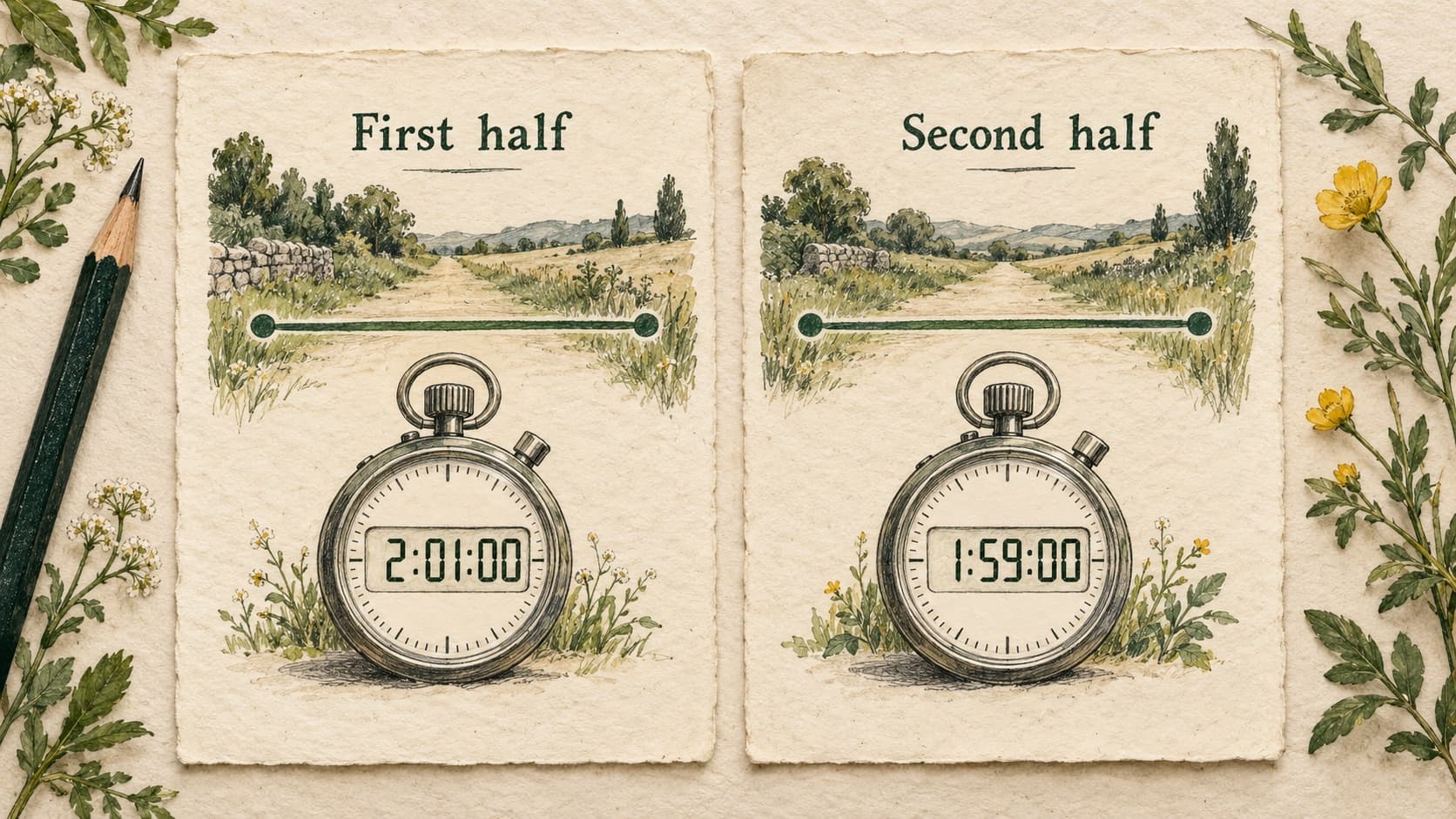
For a four-hour marathon, an even split is 2:00:00 plus 2:00:00. If you want the second half to be two minutes quicker, the halves must be 2:01:00 and 1:59:00. The average paces display 5:44/km and 5:38/km.
For a two-hour half marathon with a one-minute gap, use 1:00:30 and 0:59:30. The average paces again display 5:44/km and 5:38/km, because both the distance and time are half as large.
The first half is slower than half the target by half the chosen gap. In general, first-half time is half the target plus half the gap. Second-half time is half the target minus half the gap.
These examples explain the arithmetic. They do not establish a best gap or say that you should delay a large part of the work until late in the race.
Even pace and even effort answer different questions
Even pace means similar time per unit distance. Even effort means adjusting pace to the demand of the route and conditions. Your effort can feel harder late in the race even if the external workload remains similar.
Experimental research on graded running shows that the energy cost changes with slope. That is why forcing flat-ground pace on a climb can turn a measured start into a hard effort.
A downhill second half can create a negative split without a major change in effort. A hilly or exposed second half can create a positive split despite sensible pacing. Read the course before treating a split shape as success or failure.
Put restraint into the opening
Choose a goal that fits your training and check the course profile. Use the opening to settle into the planned effort. If the field pulls you faster than intended, let it go.
Check official markers and elapsed time rather than reacting to every change in instantaneous watch pace. Keep the fueling and drinking approach you practiced. An initially easy feeling does not require a faster goal.
At halfway, assess whether the effort is controlled and the conditions match the plan. Continue steadily if there is no clear reason to change. If you feel strong later, increase effort gradually. Do not force the quicker half when symptoms, heat, or terrain argue against it.
Review the reason for a slowdown
After the race, look for where the pace changed and what changed with it. A slower section into a headwind differs from a slowdown on level ground after an overfast start.
Compare route, conditions, stops, perceived effort, and heart rate where available. A single finishing pattern cannot diagnose a fueling problem or fitness change.
Yigri can keep those comparisons together. The useful question is what happened to the effort through the race, and whether the opening helped you finish as well as your preparation allowed.
Methodology and limits
This guide combines observational analyses of New York City and Vienna race pacing with experimental evidence on running energy cost at different slopes. The numerical examples are calculated from equal-distance halves. These studies do not test the examples as interventions or establish one best split gap.
- Pacing patterns among finishers show associations and do not prove that a prescribed negative split causes a faster race.
- A course with a harder second half can make a negative split unsuitable despite sensible effort.
- Effort may rise late in a race even when pace stays steady. Heart rate also responds to heat, fatigue, and hydration.
- The example split gaps are arithmetic illustrations, not evidence-based target margins.