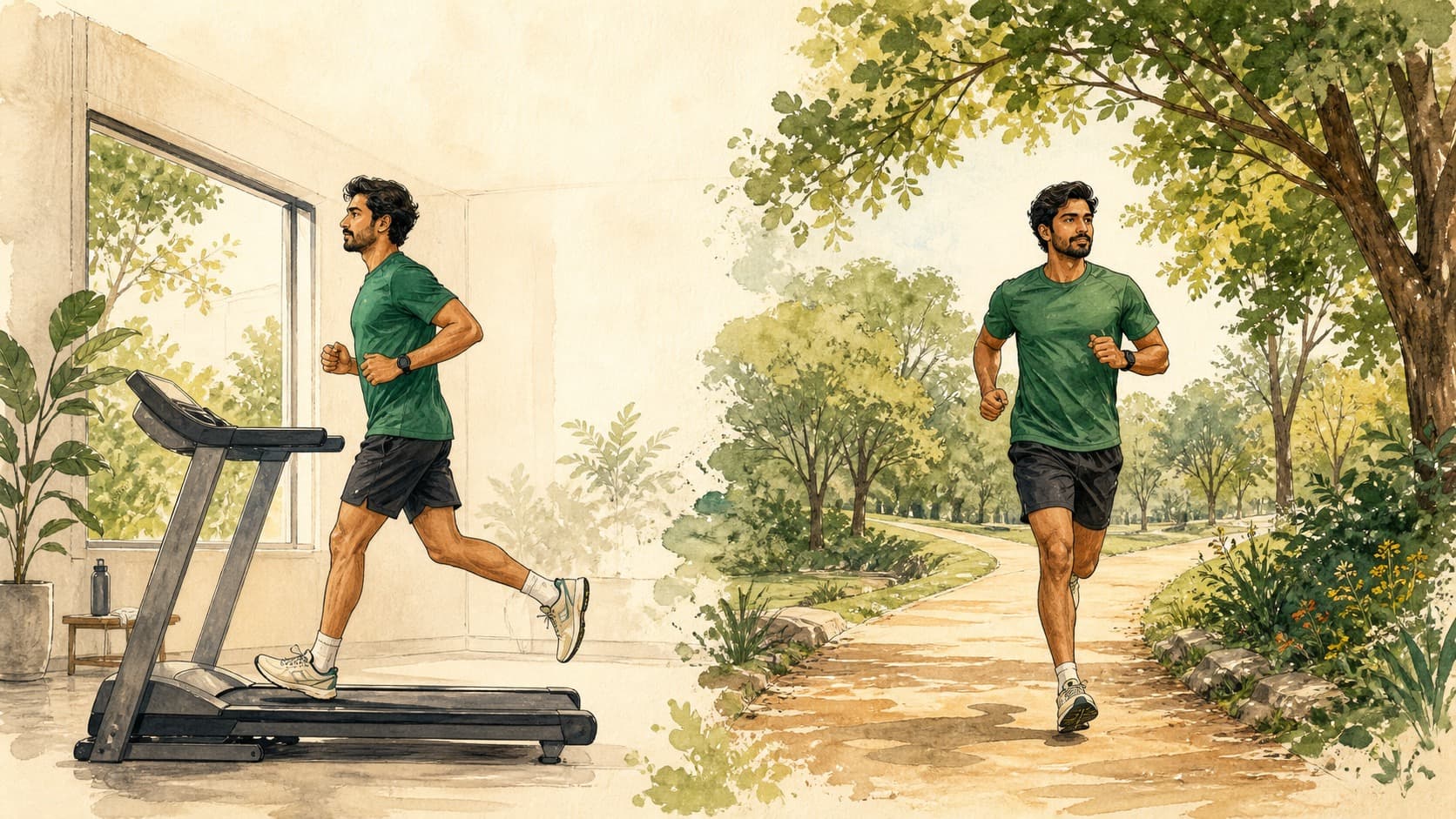
Direct answer
Is treadmill pace comparable to outdoor running pace?
Treadmill and outdoor pace are related, but they are not interchangeable. Research finds many physiological and biomechanical measures are similar, while speed, belt calibration, incline, airflow, surface, turns, weather, and treadmill familiarity can shift the result. Compare each setting with its own history first.
Treadmill pace and outdoor pace describe the same basic action, but the setting changes how that pace is produced and measured. Treating a treadmill mile as an exact substitute for an outdoor mile can turn an ordinary context difference into a false fitness signal.
What the research finds
A 2019 systematic review compared physiology, perceived effort, and performance across 34 crossover studies. Some measures were similar between treadmill and outdoor running, while others changed with speed and test conditions. Heart rate and perceived effort were not consistently higher in one setting across all submaximal speeds.
A separate review of 33 biomechanics studies found that most measured outcomes were broadly comparable. It also found differences in measures such as foot angle at landing, knee motion, contact time, and propulsive force. "Comparable" does not mean identical.
The familiar advice to set a treadmill to 1% incline came from a 1996 experiment with nine trained men. In short runs at the tested speeds, 1% produced an oxygen cost close to level outdoor running. That result can be useful context, but it is too narrow to serve as a universal pace conversion for every runner, speed, treadmill, or workout.
Why the same number can feel different
On a treadmill, the belt fixes the speed. There are no corners, surface changes, or small pacing decisions unless you change the controls. Indoors, limited airflow can raise heat strain even when the room feels comfortable. The displayed speed also depends on the machine's calibration.
Outdoors, wind, grade, temperature, footing, and turns all affect the pace. GPS adds its own measurement noise, especially near buildings, trees, or tight bends. You choose the speed continuously rather than following a moving belt.
Familiarity matters too. Some runners relax on a treadmill; others shorten their stride or feel less stable. Those individual responses are one reason a single conversion rule performs poorly.
Which pace should guide training
Use the setting that matches the job. A treadmill is useful for controlled intervals, steady climbing, or running when outdoor conditions are unsafe. Outdoor running gives you practice with the terrain, weather, and self-pacing you will face outside.
For analysis, compare like with like:
- Compare treadmill sessions with prior runs on the same machine when possible.
- Compare outdoor sessions with similar routes and conditions.
- Match workout type, duration, and recovery before reading a pace change as fitness.
- Use heart rate and perceived effort as context, not as perfect conversion tools.
If treadmill pace improves across repeated, similar sessions, that trend is useful. The same is true outdoors. The mistake is assuming the gap between the two settings has one fixed value.
Yigri can keep indoor and outdoor baselines separate while reading pace and heart rate in the context of the workout. That makes the comparison about your trend, not a generic conversion chart.
Structured comparison
Use treadmill and outdoor pace as related but separate baselines. Compare the same setting, effort, and workout type before drawing a fitness conclusion.
| Criterion | Treadmill running | Outdoor running |
|---|---|---|
| Pace measurement | Set by the belt and dependent on calibration | Estimated by GPS, course measurement, or lap timing |
| Environment | Stable surface with limited airflow and no turns | Affected by wind, weather, surface, elevation, and turns |
| Effort | Can feel easier or harder depending on speed, cooling, and familiarity | Changes with conditions and the runner's pacing choices |
| Best comparison | Previous runs on the same treadmill | Previous runs on a similar route in similar conditions |
Methodology and limits
This comparison draws on two systematic reviews of crossover studies and one controlled experiment behind the familiar 1% incline rule. It treats their group findings as context and does not convert treadmill pace into a guaranteed outdoor equivalent.
- A treadmill's displayed speed can differ from its actual belt speed, and calibration quality varies by machine.
- The 1% incline finding came from nine trained men running short stages at a limited range of faster speeds.
- Outdoor surfaces, corners, wind, temperature, and GPS measurement add differences that a laboratory comparison cannot reproduce.
Sources
- A Systematic Review and Meta-Analysis of Crossover Studies Comparing Physiological, Perceptual and Performance Measures Between Treadmill and Overground Running
- Is Motorized Treadmill Running Biomechanically Comparable to Overground Running? A Systematic Review and Meta-Analysis of Cross-Over Studies
- A 1% treadmill grade most accurately reflects the energetic cost of outdoor running