Direct answer
What pace do I need for my marathon or half-marathon goal?
Divide your target finish time by 42.195 km for a marathon or 21.0975 km for a half marathon. That gives the average pace required across the whole race. Checkpoints translate the same target into elapsed times. They describe a pacing plan; they do not show whether your training or race conditions support the goal.
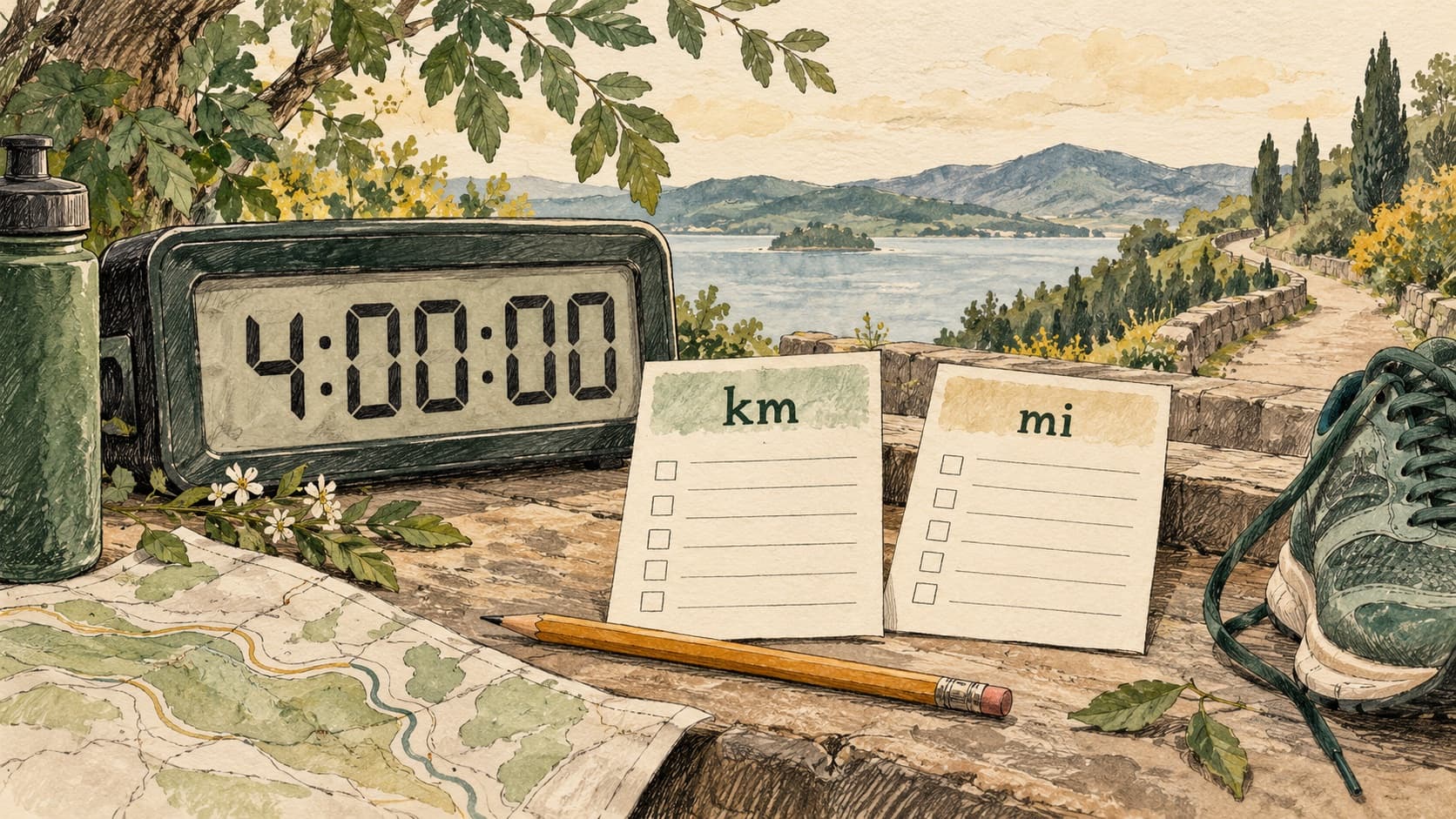
Use the marathon and half-marathon pace calculator to set a target time and print your splits.
A finish-time goal becomes more useful when you can check it against course markers. Start with a goal your training supports, then turn it into elapsed times.
Choose your race distance and a target time grounded in your recent training. The same arithmetic gives kilometer or mile checkpoints, including the short final segment.
From finish time to pace
A marathon is 42.195 km. A half marathon is 21.0975 km. Common labels such as 26.2 miles and 13.1 miles are rounded descriptions, so they should not be the distance used in the calculation.
For a four-hour marathon, 14,400 seconds divided by 42.195 gives 341.2726626 seconds per kilometer. The displayed pace is 5:41/km, or 9:09/mile. Keep the full value when calculating checkpoints.
A two-hour half marathon has the same average pace. A 3:30 marathon and a 1:45 half marathon both display 4:59/km, or 8:01/mile.
Read checkpoints as elapsed time
For the four-hour marathon example, the even-pace checkpoints are:
- 5 km in 28:26.
- 10 km in 56:53.
- Halfway, 21.0975 km, in 2:00:00.
- 30 km in 2:50:38.
- 40 km in 3:47:31.
- The finish, 42.195 km, in 4:00:00.
Those are times since the start. They are different from the duration of the latest kilometer or mile. Decide whether your goal uses chip time or gun time and check the race's timing rules. Do not compare a chip-time plan with a clock that includes time spent waiting to cross the start.
Why the final row is shorter
Kilometer splits end with 195 meters after 42 km in a marathon, and 97.5 meters after 21 km in a half marathon. Mile splits also end with a partial mile.
The four-hour marathon's final 195 meters take about 1:07 at even pace. The two-hour half marathon's final 97.5 meters take about 0:33. Giving either finish another full kilometer would overshoot the race distance and the target time.
Rounding changes the printed numbers
The four-hour target displays 5:41/km, but the exact average is a little over 5:41. Multiplying 5:41 by the race distance gives a slightly different finish time. Use the checkpoint chart instead.
The printable charts round elapsed checkpoints to the nearest second. The displayed interval time is the difference between consecutive displayed checkpoints, so interval seconds add back to the displayed finish. Some intervals differ by a second because of rounding.
Choose a pace your training supports
A calculator can make an unrealistic target look precise. Look at the consistency of your training, your long runs, and recent races before choosing the finish time.
Use hill context and heat context when comparing the target with training. A steady effort on a climb can produce a slower split. A pace that was comfortable on a cool morning may ask too much on a hot race day.
A negative-split target uses the same finish time
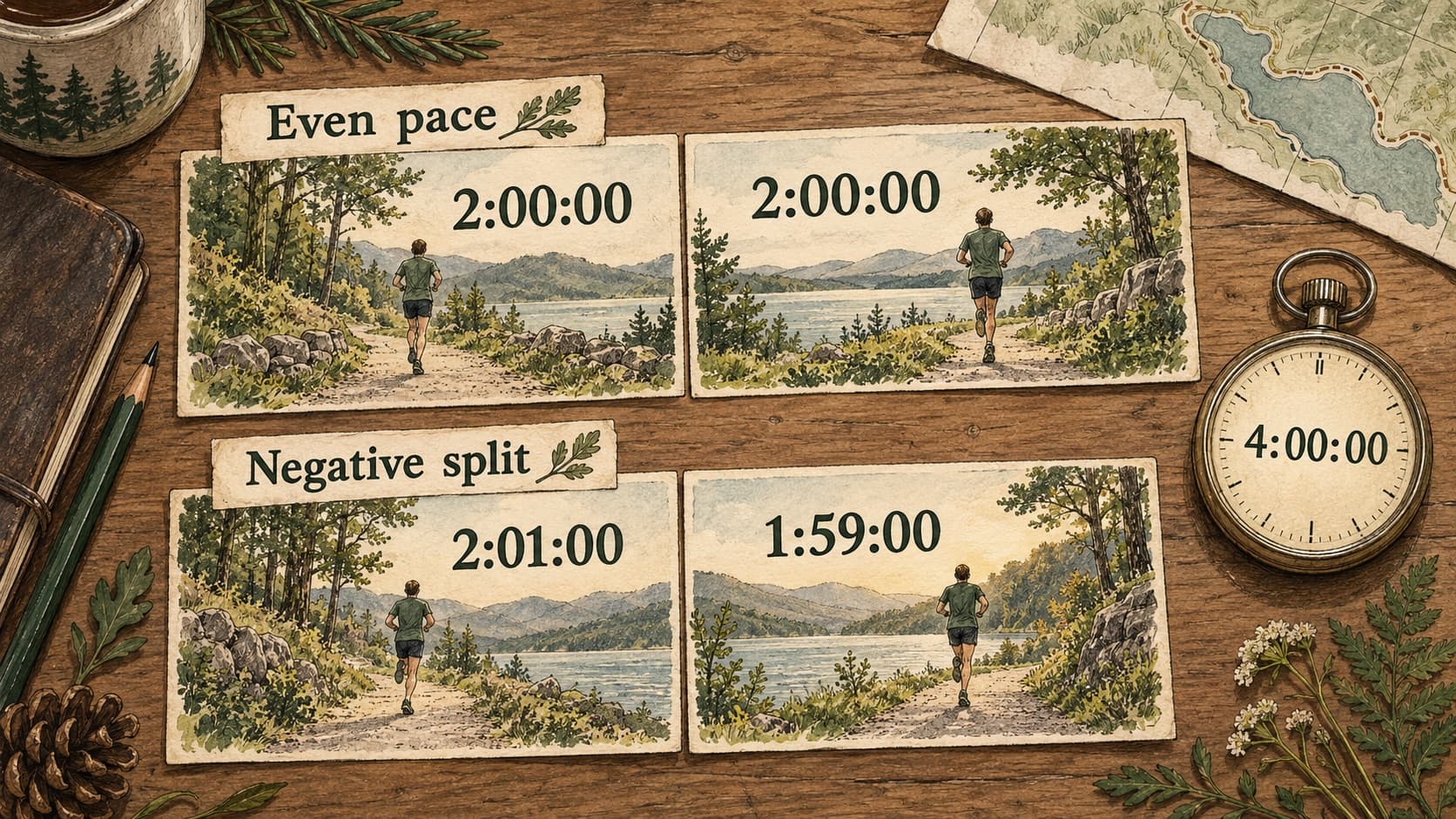
For a four-hour marathon with the second half two minutes quicker than the first, the halves are 2:01:00 and 1:59:00. Their average paces display 5:44/km and 5:38/km.
The two-minute figure is the difference between halves. It is not two minutes added to the first half of an even split. This is an arithmetic example, not a recommendation to force that change on every course.
Use the chart without chasing every second
Check elapsed time at reliable markers, and read it alongside effort and conditions. Avoid a sudden surge to erase a few seconds at one marker. On a course with a difficult second half, protecting your effort may matter more than producing identical splits.
Yigri can place a target beside recent pace, heart rate, route, and weather context. The arithmetic tells you what the goal requires. Your training and race day determine whether that plan is sensible.
Methodology and limits
The calculations use the official race distances and the international mile of exactly 1.609344 km. Checkpoint times come from unrounded pace. Examples use even pace; the negative-split example divides the target time between equal-distance halves. No physiological performance model is involved.
- A calculated pace is a target, not a prediction of your finish time or proof of race readiness.
- Hills, wind, heat, congestion, and aid stops change the effort needed to hold a pace.
- A watch can measure a longer or shorter distance than the certified route. Follow official course markers when checking elapsed time.
- Displayed seconds are rounded. Do not multiply the displayed pace to recreate the target; use the elapsed checkpoint times.